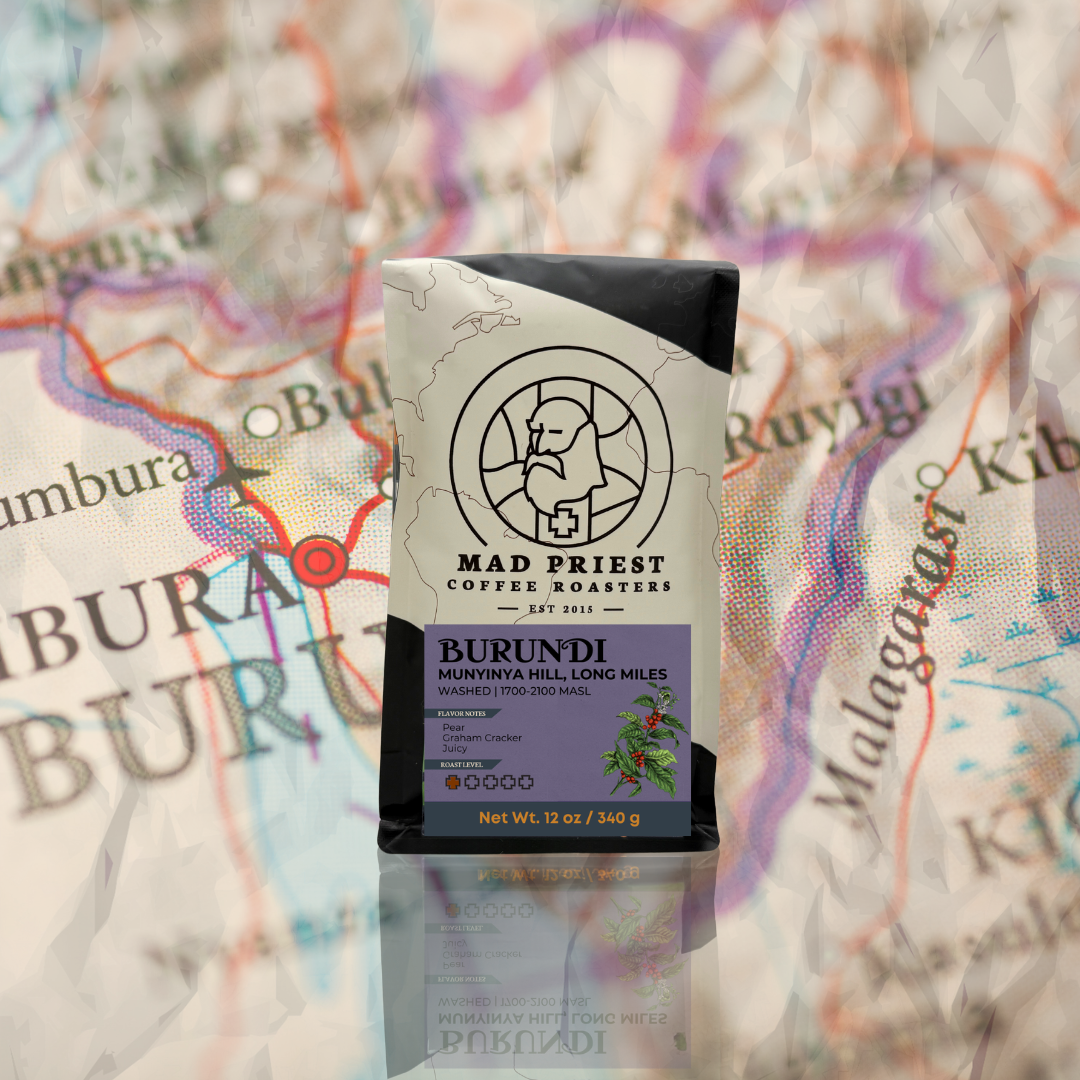
Burundi | Long Miles Coffee Washed

Burundi | Long Miles Coffee Washed

Regular price$19.99
/
Shipping calculated at checkout.

Size
Grind

👁 The Divine Details

  • Origin: Burundi
  • Region: Munyinya Hill, Gitega
  • Process: Washed
  • Variety: Bourbon
  • Altitude: 1,700-2,200 MASL
  • Roast Level: Light
  • Flavor Notes: Pear, Graham Cracker, Juicy

🕯️ The Sensory Sacraments

A humble attempt to quantify the ineffable joys (and judgments) of this cup.

  • Body
  • Acidity
  • Sweetness
  • Balance
  • Finish
  • Complexity

Coffee has a storied past in Burundi, one of the world’s poorest countries. It was introduced to the country in the 1920s under Belgian colonial rule, and all of the farmers were given coffee seedlings and forced to cultivate them with very little resources, support, or compensation to do so. 

Burundi is currently struggling to emerge from a 12-year, ethnic-based civil war that began in 1993. But it has been experiencing conflict since its independence from Belgium in 1962, and the country's history is marked by violent tensions between the Hutu majority and the Tutsi minority. Against this backdrop, a new generation of coffee farmers are emerging!

This coffee, like all others we've had from Long Miles, is simply delicious. Clean, smooth and flavorful, it carries itself as a staple in anyone's coffee inventory.

From our Importers Osito Coffee:

Bukeye Washing Station is located on the northern border of the Kayanza Province, in Gitega Province, and is named for the Bukeye village, which sits at 1,760 m.a.s.l. Bukeye washing station is located just beyond the village and has its own borehole and a granite-filtered well. This is the birthplace of Long Miles and of the Coffee Scouts program. Bukeye washing station has been the launching pad for an extensive organic pesticide program targeting antestia (the colorful bug linked to the potato defect), as well as post-harvest pruning, mulching, and fertilizing campaigns. It has been operational since April 2013. During the washed process, freshly harvested cherries are delivered by farmers to the washing station, floated, and hand-sorted for ripeness upon arrival. The cherries are pulped and undergo a single fermentation process. Parchment spends around 12 hours dry fermenting. The parchment is sometimes ‘footed’ after fermentation. A team will agitate and dance on the slippery coffee parchment with their feet, helping to loosen any remaining mucilage. It is then rinsed,
graded by density, and left to soak for another four to six hours in the final rinse tank. The parchment is carried to covered drying tables, where it spends between six and 48 hours pre-drying. During this time, it is hand-picked for under-ripeness, over-ripeness, insect damage, and visual defects. It is then moved to traditional African-raised tables, where it slowly dries for 16 to 20 days (depending on the weather) until it reaches the desired 10.5% moisture level. During the natural process, cherries are floated, hand-sorted, and then placed directly on the drying tables. The whole cherry spends 25-30 days drying in its skin, slowly turning from deep red to a prune-like purple-black when fully dry, reaching a moisture level of 10.5%.

Munyinya was the first hill that made the LM team realize that Burundi coffee had the potential to produce amazing microlots. Munyinya lies just beyond the border of Bukeye commune. The dirt road winding towards the hill is cut into the side of steep slopes that drop into cinematic views of the valleys below. Coffee trees line the steady incline that leads to the tiny town center. Despite its beauty, it was a hill that Long Miles almost gave up on because, year after year, farmers kept delivering bad-quality cherries. But when a hill holds as much potential as Munyinya, the challenge is welcome and ultimately very worth it.

Check out Long Miles Coffee Project for more awesome info and stories on coffee in Burundi: https://www.longmilescoffeeproject.com/a-history-of-coffee-in-burundi-and-why-we-started-farmer-field-schools/